Multi-Tiered Systems of Support in RFSD

The Roaring Fork School District is committed to supporting the academic, behavioral, and social-emotional growth and progress of our students.

Family collaboration is an important part of MTSS, and research shows that strong family, school, and community partnerships have a positive impact on student outcomes.

Tiers of Support in RFSD

What is Multi-Tiered Systems of Support?

Many children successfully learn at school with high-quality classroom instruction and support; however, some children need additional support in order to thrive. The MTSS framework helps schools and teachers provide students with the instructional resources they need to learn, grow, and succeed.

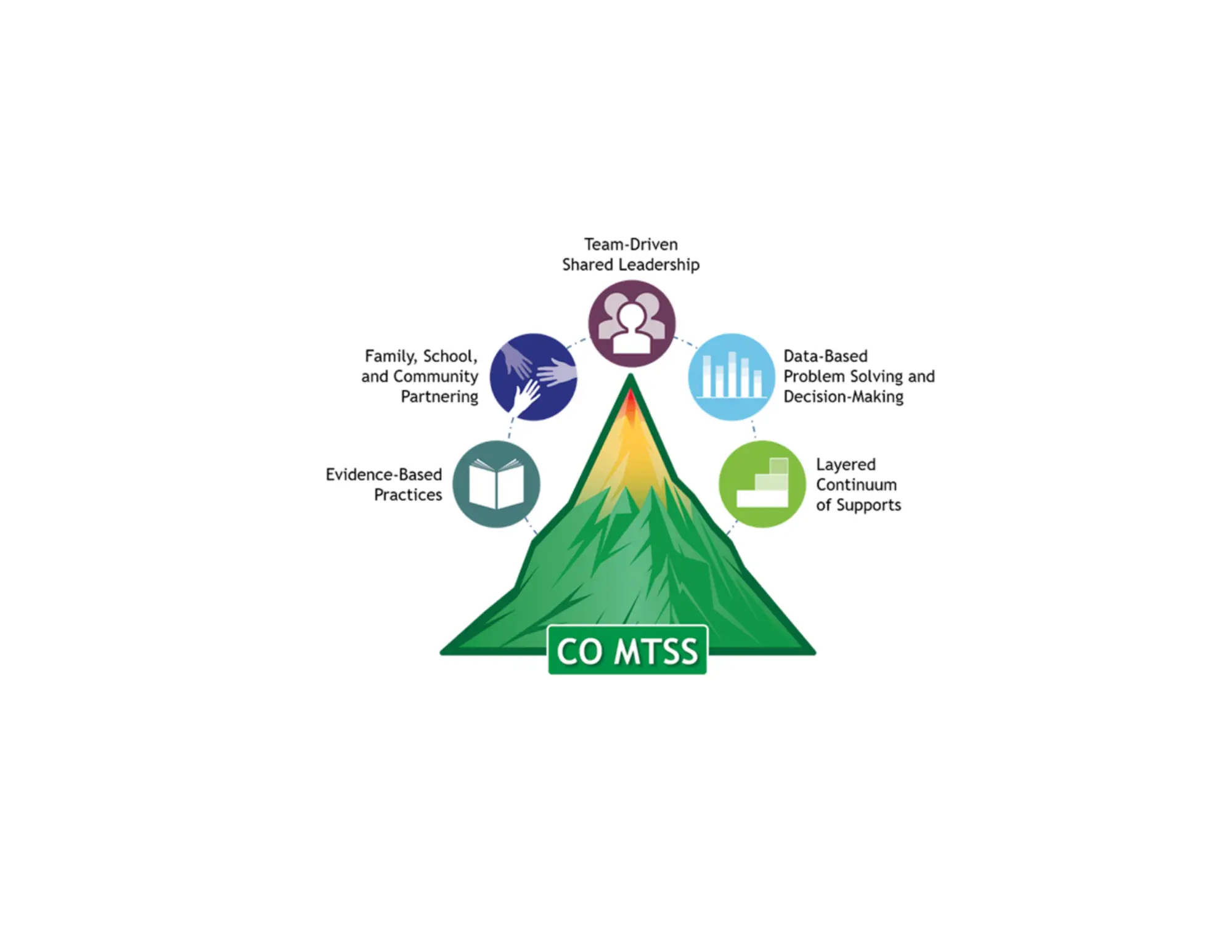
Multi-Tiered Systems of Support (MTSS) allows schools to proactively ensure all students succeed in all aspects of their educational journey through the appropriate intervention(s) and support(s) by:

  • Using teams to solve problems,
  • Looking at data to make decisions,
  • Working collaboratively with families and the community,
  • Providing students with different levels of support tailored to their individual needs.

MTSS has three tiers of instruction/intervention and support:

  • Tier One: (Universal) includes the instruction and support provided to all students.
  • Tier Two: (Targeted Small-Group) serves students who need additional support. These students receive additional instruction, intervention, and support in small groups in the classroom and during the school’s intervention block.
  • Tier Three: (Intensive) is for students who need intensive support to succeed. Additional instruction, intervention, and support are provided to these students in even smaller groups or in one-on-one settings.
Frequently Asked Questions

    What is our role as a family, within MTSS?
    1. Make sure your child is in school every day.
      • By being in school every day, students are able to collaborate and learn together, and teachers are able to provide the in-the-moment and scheduled support students need.
    2. Make reading an everyday habit at home, including reading to your child.
      • Reading can happen in your family's native language AND the language your child is learning.
    3. Work with your child at home on homework as best you can; it can be as simple as just listening and asking questions.
    4. Find time to meet with your child's teachers, family liaison, counselor, or other trusted adults to work together on goals you have for your child.
    5. Attend conferences and other school meetings about your child and share the goals and hopes you have. Be sure to bring up what your child has shared with you about how school is going for them.
    6. Ask your child’s teacher about the progress your child is making in their classes.
      • Teachers can show you your child's progress on assessments and assignments. Be sure to celebrate the growth and the progress your child is making!
      • If your child is enrolled in one of our Dual-Language communities, be sure to celebrate the growth in their language development in both Spanish and English.
    7. Check on your child’s performance frequently.
      • Each building uses Schoology and Infinite Campus to monitor your child's assignments, class progress, and overall performance.
    How long will my child stay in the MTSS process?

    Multi-Tiered Systems of Support is not a class or a curriculum that your child receives. The purpose of MTSS is to identify where our students are in our classrooms and as individuals and to determine the just-right intervention and/or support needed. These interventions take place in their classrooms, in small groups, and one-on-one as needed. The hope for all students is that they receive the appropriate support as needed to ensure they meet proficiency in all academic, behavioral, and social-emotional areas.

    What is the purpose of interventions, and how do they support my child?

    The purpose of interventions is to teach the identified area of need in a small-group or one-on-one setting to meet each individual students' needs. Interventions can be used to support literacy, math, behavior, and social-emotional skills.  An intervention can vary greatly depending on the skills, the severity of the need, and the student's age/grade level. It may be weeks or years! Teams ensure the intervention is evidence-based and taught as planned. Progress monitoring data is tracked to measure the student's growth. Teams set short-term goals that are reviewed frequently to ensure the student is moving closer to where they need to be. An intervention is continued with a new short-term goal if it’s working and changed when it’s not.

    If my student is receiving interventions within the MTSS process, does that mean they will qualify for Special Education services?

    No, MTSS is not a pathway to Special Education. Our goal is not to identify students with a learning disability if there is no evidence showing that a possible disability is a concern. Rather, we want to continue the journey alongside you and your child and adjust our instruction and individual interventions as needed.  The goal of providing interventions is to increase student success and access to learning by matching them to students' needs.

    I would like more information

    Please reach out to your child's school for more specific information regarding their MTSS systems and supports.

    You can also click on the link below to access the Colorado Department of Education and MTSS.